

The romanticized narrative of the modern startup usually goes like this: an entrepreneur gets a brilliant idea, builds a slick slide deck, pitches a room full of venture capitalists, and walks away with a multi-million-dollar check to change the world.
But behind the flashy headlines of massive funding rounds lies a harsh reality. Raising outside capital means giving up equity, relinquishing control, and trading your original vision for the aggressive, often unsustainable growth metrics demanded by investors.
Fortunately, there is another way. It’s called bootstrapping.
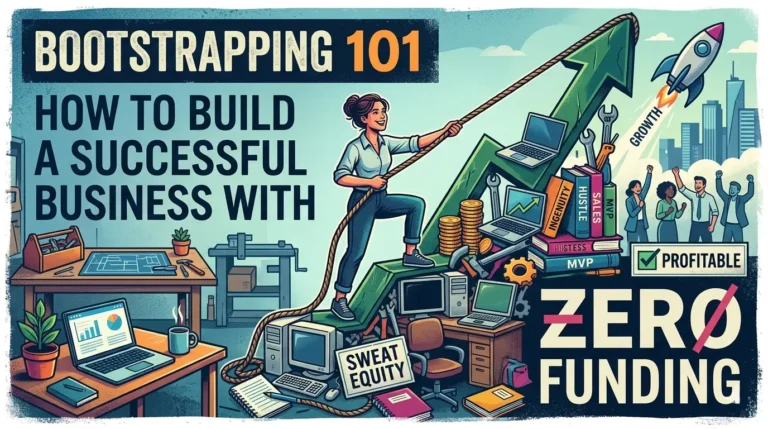
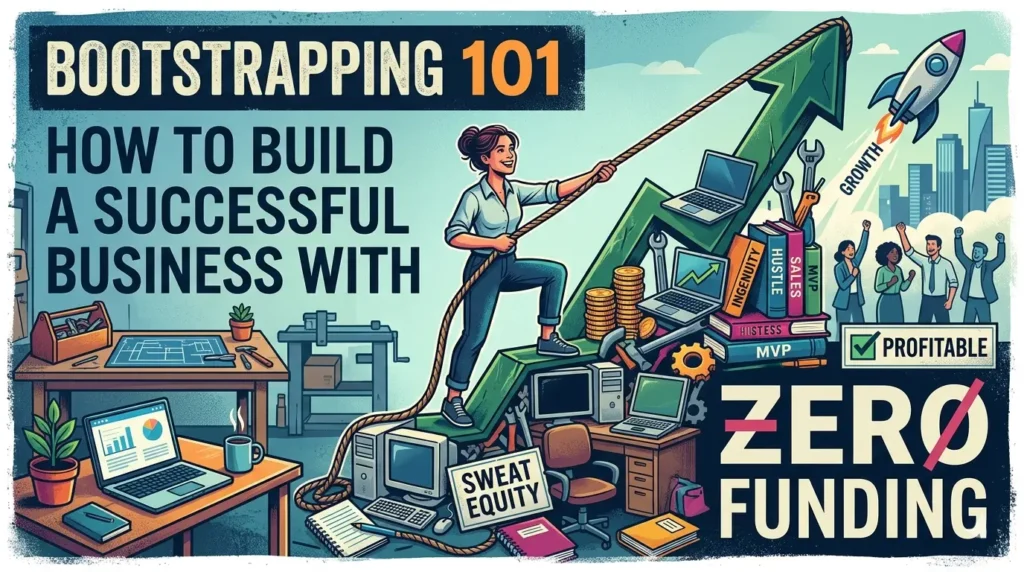
Bootstrapping is the process of building a business from the ground up using nothing but personal savings, sweat equity, and early customer revenue. It is the ultimate test of resourcefulness, creativity, and operational efficiency. Far from being a fallback plan, bootstrapping is a deliberate strategy that allows you to maintain 100% ownership of your company, stay agile, and build a business fundamentally rooted in profitability.
Whether you are looking to launch a side hustle or build the next great software enterprise, this comprehensive guide will give you the foundational blueprint to build a successful business with zero outside funding.
1. The Bootstrapper’s Mindset: Shifting from Spending to Monetizing:
The biggest obstacle for a bootstrapped entrepreneur isn’t a lack of cash; it’s a lack of the right mindset. When you have millions in the bank, you solve problems by throwing money at them. When you have zero funding, you solve problems with ingenuity, speed, and sales.
To survive the early days of bootstrapping, you must adopt three core psychological shifts:
Fall in Love with Cash Flow, Not Valuation:
Funded startups often focus on vanity metrics like user acquisition numbers, market share, or theoretical valuations. As a bootstrapper, your only metric of survival is cash flow. Cash is the oxygen of your business. If more cash is leaving the bank than entering it, your business will suffocate. Every decision you make must be evaluated through a simple lens: How quickly will this generate revenue?
Embrace the “Do It Yourself” (DIY) Ethos:
In a funded company, you hire a graphic designer for the logo, a copywriter for the website, and an agency for the marketing. In a bootstrapped company, you are the agency.
You will wear every hat—from customer support agent and accountant to salesperson and janitor. This isn’t just a cost-saving measure; it’s a competitive advantage. By doing the work yourself initially, you master the core operational mechanics of your business, which ensures you will know exactly who and what to look for when you are finally ready to hire.
Progress Over Perfection:
Perfectionism is a luxury funded companies can afford to waste time on. For you, perfectionism is a liability. Waiting to launch until your product or service is “perfect” gives your competitors time to move and drains what little personal capital you have.
Launch early, launch ugly, and iterate based on real feedback from real paying customers.
2.Validating Your Idea Without Spending a Dime:
One of the most common reasons businesses fail is that they build something nobody actually wants. When you are bootstrapping, you cannot afford to waste six months and thousands of dollars developing an unproven concept. You must validate market demand before you invest serious time or money.
Validation means proving that people have a painful problem and are actively willing to pay money to have it solved. Here is how to validate your idea for free:
Conduct Deep Audience Research:
Before writing a single line of code or buying inventory, hang out where your target customers congregate online. Look at Reddit communities, Quora threads, Facebook Groups, and specialized forums.
Do not post sales pitches. Instead, look for patterns in their complaints. What are they frustrated by? What workarounds are they currently using? What software or services do they openly complain about?
The Mom Test: Talk to Potential Customers:
Coined by author Rob Fitzpatrick, “The Mom Test” is a framework for talking to customers without asking them if your idea is good (because people will lie to be polite). Instead, ask them about their past behavior.
- Bad question: “Would you buy an app that does X?”
- Good question: “How do you currently handle X? How much does that cost you? When was the last time you tried to fix that problem?”
If they haven’t actively spent time or money trying to solve the problem in the last 6 months, it isn’t a painful enough problem to build a business around.
Create a Landing Page and Gather Pre-Orders:
The ultimate validation is money changing hands. You can build a free landing page using platforms like MailerLite, Carrd, or Notion. Write a compelling description of your product or service, outline the benefits, and include a clear call to action (CTA).
If you can get 10 to 20 people to pre-order or sign up for a high-intent waitlist based purely on a landing page concept, you have validated your idea. If you can’t get anyone to sign up, it’s time to pivot your angle before spending a dime.
3. Building Your MVP (Minimum Viable Product):
Once your idea is validated, your next goal is to get a Minimum Viable Product (MVP) into the market. An MVP is the absolute simplest version of your product or service that still delivers core value to the customer.
The mistake most founders make is thinking an MVP requires custom software, manufacturing contracts, or complex infrastructure. It doesn’t.
The Service-First Approach:
If your ultimate goal is to build a complex software-as-a-service (SaaS) platform, start by offering the solution manually as a service.
Want to build an AI-powered automated bookkeeping tool? Start by doing the bookkeeping manually for 5 local clients using Excel sheets. This allows you to learn the exact workflows, pain points, and edge cases completely for free while charging money from day one. You can use that revenue to fund the automation later.
Leveraging the No-Code Ecosystem:
The barrier to entry for building digital tools has never been lower. You no longer need to hire expensive software developers to launch a tech product. You can stack free or low-cost “no-code” tools to create highly functional MVPs:
- Websites & Portals: Webflow, Softr, Bubble
- Databases & Backends: Airtable, Google Sheets
- Automation & Workflows: Make.com, Zapier
By connecting a simple front-end interface to an Airtable database via Zapier, you can mimic complex software functionality at a fraction of the cost.
4. The Zero-Dollar Tech Stack for 2026:
To keep your overhead at zero (or as close to it as possible), you need to take advantage of the massive ecosystem of powerful, free tier business tools available today.
| Business Need | Tool | Free Tier Capabilities |
| Website / Landing Page | Carrd / Notion | Free subdomains, beautiful templates, basic hosting. |
| Project Management | Trello / Notion | Task tracking, content calendars, and documentation. |
| Communication | Slack / Zoom | Internal team chats and 40-minute free client video calls. |
| Design & Branding | Canva | Professional logos, social graphics, and pitch decks. |
| CRM & Invoicing | Wave Invoicing / HubSpot | Free invoicing, expense tracking, and contact storage. |
| Email Marketing | ConvertKit / MailerLite | Collect up to 1,000 subscribers and send automated newsletters. |
By utilizing these free tools, your only fixed cost should be your domain name (typically around $10 to $15 a year). Guard your cash aggressively; do not upgrade to premium tiers until your business revenue naturally justifies the expense.
5. Organic Customer Acquisition Strategies:
When you have zero funding, paid advertising (like Google Ads or Meta Ads) is out of the question. You cannot afford to burn cash testing ad creatives or bidding on expensive keywords. Instead, you must rely on organic growth engines that cost time, not money.
Content Marketing & SEO (Search Engine Optimization):
Content marketing is the long-term engine of a bootstrapped business. By creating highly informative, evergreen content that solves your audience’s problems, you earn free traffic from search engines day after day.
To rank on search engines without a massive backlink profile, focus on Long-Tail Keywords. These are specific, three-to-five-word phrases that have lower search volumes but highly targeted intent.
For example: Instead of trying to rank for the highly competitive keyword “accounting software,” create a comprehensive guide targeting “free accounting software for solo freelance graphic designers.”
Organic Social Media & Thought Leadership:
Platforms like LinkedIn, X (Twitter), and TikTok are digital meritocracies where high-quality content can achieve massive reach without spending a dollar on ads.
Build a personal brand around your entrepreneurial journey. Document your process openly: share your wins, analyze your failures, expose your revenue metrics, and explain what you are learning along the way. This “building in public” strategy builds intense, authentic loyalty. People don’t just buy your product; they buy into your story and cheer for your success.
Cold Outreach & Direct Sales:
If you are running a business-to-business (B2B) service or agency model, cold outreach is your fastest path to dollar one. It requires thick skin, but it is entirely free.
Use LinkedIn to identify exact decision-makers who fit your ideal customer profile. Send them a highly personalized, low-friction message.
- Do not: Pitch your service immediately in a giant wall of text.
- Do: Point out a specific gap or problem they currently have, offer a free piece of advice or value to fix it, and ask if they’d be open to a brief 10-minute chat.
6. Managing Cash Flow: The Rules of Financial Survival:
Many bootstrapped businesses that are technically “profitable” on paper still go bankrupt because they run out of liquid cash. Managing your finances as a bootstrapper requires iron-clad discipline.
Postpone Hiring as Long as Humanly Possible:
Salaries are the single largest expense for almost every business. Every full-time hire you make dramatically increases your monthly burn rate (the amount of money you spend each month to stay operational).
Instead of hiring full-time staff early on, rely on freelancers and contractors via platforms like Upwork or Fiverr to handle specialized, project-based tasks. Better yet, look into how you can use AI tools to automate repetitive workflows like writing basic copy, sorting emails, or organizing data before paying human labor costs.
Negotiate Favorable Payment Terms:
If you buy inventory or physical goods, negotiate with suppliers for longer payment terms (e.g., Net-30 or Net-60, meaning you pay 30 or 60 days after receiving the goods).
Conversely, when dealing with clients, always demand an upfront deposit or require immediate payment upon invoicing. The goal is to collect cash from your customers before you have to pay the expenses required to deliver the service.
Keep Your Fixed Overhead Razor-Thin:
Do not rent an office space; work from home, a public library, or a local coffee shop. Do not buy premium corporate software if a free open-source alternative exists. Review your bank statements monthly and ruthlessly cancel any subscription or tool that isn’t actively generating revenue or saving you crucial time.
7. When and How to Reinvest for Exponential Growth:
Bootstrapping does not mean staying small forever. It means funding your growth through your own success rather than investor cash injections.
Once your business is consistently generating more money than it takes to cover your basic living or operational costs, you enter the reinvestment phase. How you deploy this capital determines whether your business plateaus or scales.
- Emergency Cash Reserve (3-6 Months of Overhead)
- Revenue-Generating Infrastructure & Paid Tools
- Outsourcing Low-Leverage Tasks (Freelancers/VA)
- Scalable Growth Channels (SEO/Paid Ads/Strategic Hires)
First, build an emergency cash reserve equal to three to six months of operational overhead. This protects you from seasonal downturns, client churn, or unexpected economic shifts.
Second, reinvest in tools that directly buy back your time or increase your capacity. Upgrade from the free tiers of your software stack to unlock advanced automations, higher limits, and deeper data analytics.
Third, begin outsourcing your lowest-value tasks. If you spend five hours a week manually inputting invoices or scheduling social media posts, hire a virtual assistant (VA). This frees up your creative energy to focus exclusively on high-leverage activities: improving your product, closing big deals, and engineering your long-term growth strategy.
Conclusion: The Freedom of the Bootstrapped Founder:
Building a business with zero funding is undeniably difficult. It requires longer hours, greater patience, and an immense tolerance for rejection and ambiguity in the early stages. You will move slower than your venture-backed competitors who have millions to burn on hyper-growth.
But what you build will be fundamentally resilient.
Because you didn’t have cash to burn, you were forced to build an efficient operational engine, master direct customer acquisition, and create a product that people genuinely love enough to pay for. You answers to no board of directors, no venture capitalists, and no outside investors.
You own 100% of your company, 100% of your profits, and 100% of your destiny. That absolute creative and financial freedom is the ultimate reward of the bootstrapped founder. Stop waiting for someone to hand you a check. Grab your domain, launch your MVP, and start building your business today.