


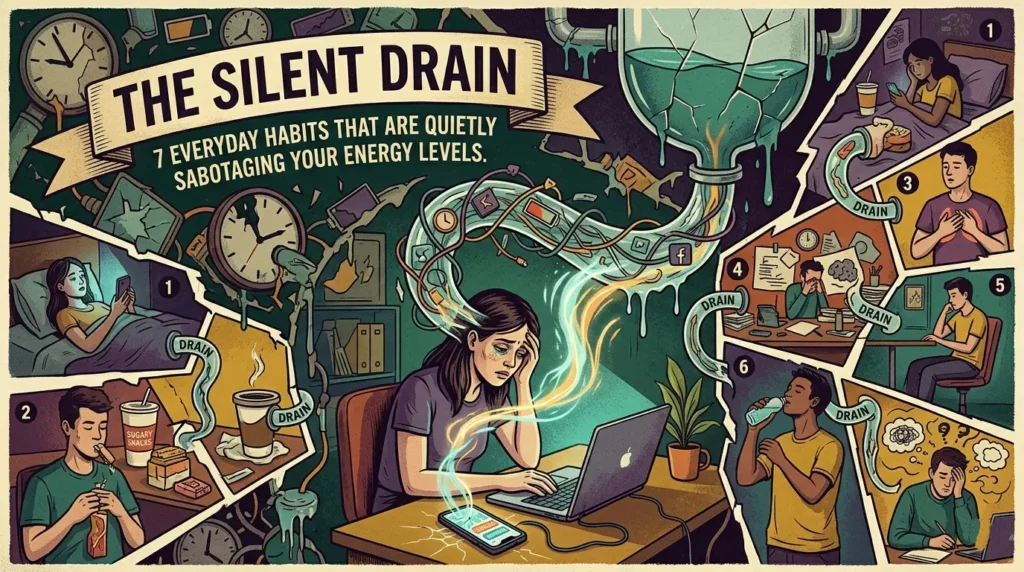
Do you wake up feeling just as exhausted as when your head hit the pillow? Do you find yourself trapped in a midday brain fog, relying on a third cup of coffee just to survive the afternoon slump?
If you are constantly battling chronic fatigue, you are not alone. Millions of people live in a perpetual state of low energy, chalking it up to a busy schedule, getting older, or stress. But more often than not, the true culprit isn’t a medical condition or a lack of sleep duration. Instead, it is a collection of invisible, seemingly harmless routines built into your daily life.
These are the silent drains—everyday habits that feel completely normal but act as microscopic leaks in your biological battery.
To reclaim your vitality, you must look past the obvious and examine the subtle behaviors that are quietly sabotaging your cellular energy. This comprehensive guide breaks down the science behind the seven most common energy-draining habits and provides actionable, evidence-based strategies to plug the leaks and supercharge your daily performance.
1. The “Blue Light” Wind-Down Routine:
Many people finish a long day by climbing into bed and scrolling through social media, watching a television show, or checking emails on a smartphone to “relax.” While your mind might feel like it is winding down, your brain is experiencing a completely different reality.
The Science Behind the Drain:
The human body operates on a tightly regulated internal clock known as the circadian rhythm. This rhythm is dictated almost entirely by light exposure. Digital screens emit a high concentration of artificial blue light, which mimics the wavelength of morning sunlight.
When you stare at a screen in the dark, this blue light penetrates your retina and sends a signal to your brain’s suprachiasmatic nucleus to suppress the production of melatonin—the hormone responsible for deep, restorative sleep.
- [ Light Exposure & Melatonin Production ]
- Daytime (Natural Sunlight) -> High Cortisol / Low Melatonin = Alertness
- Nighttime (Screen Exposure) -> Suppressed Melatonin = Disrupted Sleep Architecture
- Nighttime (Pitch Darkness) -> High Melatonin / Low Cortisol = Deep Cellular Repair
Even if you manage to fall asleep quickly after looking at your phone, the suppression of melatonin alters your sleep architecture. You spend significantly less time in REM (Rapid Eye Movement) and deep slow-wave sleep, leaving you feeling biologically depleted the next morning.
How to Fix It:
- The 90-Minute Digital Sunset: Disconnect from all digital screens at least 60 to 90 minutes before your planned bedtime.
- Switch to Analog: Replace late-night scrolling with reading a physical book under warm, dim lighting, journaling, or doing light stretching.
- Leverage Tech Fixes: If you absolutely must use a screen at night, turn on built-in blue light filters (such as “Night Shift” or “Night Light”) or wear certified blue-light-blocking glasses.
2. Relying on “Liquid Energy” (The Caffeine Rollercoaster):
When fatigue strikes, the instinctive response for most busy individuals is to reach for an energy drink, a soda, or another cup of coffee. While caffeine provides a temporary illusion of alertness, relying on it throughout the day actually worsens long-term exhaustion.
The Science Behind the Drain:
Throughout the day, a chemical byproduct called adenosine accumulates in your brain. The more adenosine that binds to your neural receptors, the sleepier you feel. This is known as “sleep pressure.”
Caffeine does not actually create new energy; it is simply a molecular master of deception. It shares a similar structure to adenosine, allowing it to bind to those same receptors and block the sleepiness signals from reaching your brain.
However, while caffeine blocks the receptors, the production of adenosine does not stop. It continues to pile up like water behind a dam. Once your liver metabolizes the caffeine, the massive wave of accumulated adenosine floods your brain all at once. This results in the infamous “caffeine crash,” driving you straight back to the coffee machine and trapping you in a vicious, energy-depleting cycle.
How to Fix It:
- Delay Your First Cup: Wait 90 to 120 minutes after waking up to consume your first cup of coffee. This allows your body to naturally clear out residual adenosine via cortisol production, preventing a mid-morning crash.
- Establish a Caffeine Curfew: Stop all caffeine intake by 2:00 PM. Caffeine has a half-life of roughly 5 to 7 hours, meaning a cup of coffee consumed at 4:00 PM is still actively disrupting your brain chemistry at 11:00 PM.
- Hydrate First: Drink a large glass of water before reaching for coffee in the morning to combat overnight dehydration, which is often the true cause of morning lethargy.
3. Micro-Dehydration (The Unnoticed 2% Drop):
You don’t have to be stranded in a desert to suffer from dehydration. The vast majority of working professionals live in a state of chronic, low-grade micro-dehydration without ever feeling explicitly thirsty.
The Science Behind the Drain:
Water is the primary medium for almost every single chemical reaction in the human body, including the production of adenosine triphosphate (ATP)—the currency of cellular energy.
Clinical studies demonstrate that a fluid loss of as little as 1% to 2% of your body weight is enough to cause significant drops in cognitive function, memory, alertness, and physical stamina. When your body is slightly dehydrated, your blood volume drops, making it thicker and more viscous.
Your heart is then forced to work significantly harder, pumping blood at an accelerated rate to transport oxygen and vital nutrients to your brain and muscles. This constant, low-level physical strain acts as a massive drain on your daily stamina.
- Micro-Dehydration (1-2% Fluid Loss)
- Decreased Blood Volume & Thicker Blood
- Increased Cardiovascular Workload (Heart works harder)
- Sluggish Nutrient & Oxygen Delivery
- Chronic Brain Fog and Muscle Fatigue
How to Fix It:
- The First-Thing-First Rule: Keep a 500ml glass of water on your nightstand and drink it immediately upon waking up to replace fluids lost through breathing and sweat overnight.
- Visual Management: Keep a designated, reusable water bottle on your desk at all times. If it is within your line of sight, you are significantly more likely to sip from it unconsciously throughout the day.
- Eat Your Water: Increase your intake of water-rich foods, such as cucumbers, celery, watermelons, and berries, which supply slow-release hydration alongside vital electrolytes.
4. Shallow Breathing and Chest Breathing:
Breathing is an involuntary action, so we rarely stop to think about how we are doing it. However, chronic stress, poor posture, and prolonged sitting have caused a modern epidemic of shallow “chest breathing.”
The Science Behind the Drain:
When you are stressed or hunched over a laptop, your body defaults to shallow, rapid breaths utilizing only the upper third of your lungs. This type of breathing activates the sympathetic nervous system—the body’s primal “fight or flight” response.
Chest breathing signals to your brain that you are under an immediate physical threat. This causes a cascade of cortisol and adrenaline releases, elevating your heart rate and tensing your muscles.
While this evolutionary mechanism is brilliant for escaping a predator, maintaining a low-grade fight-or-flight state for 8 hours at an office desk burns through your glycogen stores and leaves you feeling completely flattened by the end of the workday. Furthermore, shallow breathing restricts optimal carbon dioxide-oxygen exchange, lowering the amount of oxygen delivered to your brain tissues.
How to Fix It:
- Practice Diaphragmatic Breathing: Place one hand on your chest and one hand on your stomach. Practice breathing so that only the hand on your stomach moves outward. This ensures you are utilizing your diaphragm and engaging the lower lobes of your lungs.
- The 4-7-8 Breathing Reset: When you feel a wave of fatigue or brain fog, pause for two minutes. Inhale through your nose for 4 seconds, hold your breath for 7 seconds, and exhale completely through your mouth for 8 seconds. This pattern stimulates the vagus nerve, triggers the parasympathetic nervous system, and lowers your heart rate.
- Posture Checks: Set a recurring timer on your phone to check your posture. Sit up straight, roll your shoulders back, and open up your chest cavity to allow for full, unrestricted deep breaths.
5. The Glucose Rollercoaster (High-Carb, Low-Protein Lunches):
What you choose to eat for lunch can either fuel your afternoon with steady focus or send you spiraling into a deep lethargy by 3:00 PM. The classic convenience meals—sandwiches, wraps, pasta, or sugary fast-food options—are major catalysts for metabolic fatigue.
The Science Behind the Drain:
When you consume a meal heavy in simple carbohydrates, refined sugars, or processed starches, your digestive system rapidly breaks them down into glucose, causing a sharp spike in your blood sugar levels.
In response, your pancreas panics and secretes a massive surge of insulin to clear the excess glucose out of your bloodstream.
- High-Carb / Sugary Lunch
- Rapid Blood Sugar Spike (Short-lived burst of energy)
- Massive Insulin Surge by the Pancreas
- Aggressive Clearing of Blood Sugar
- Severe Glucose Crash = Systemic Fatigue & Brain Fog
This aggressive clearance causes your blood sugar to crash far below its baseline level. This sudden drop triggers systemic fatigue, irritability, and intense cravings for even more sugar or caffeine, creating a self-sabotaging loop that destroys your productivity.
How to Fix It:
- The Macro Balance Principle: Ensure every meal is built around a source of high-quality protein (chicken, fish, eggs, tofu), healthy fats (avocado, olive oil, nuts), and complex, fiber-rich carbohydrates (quinoa, sweet potatoes, leafy greens). Protein and fat slow down digestion, ensuring glucose enters your bloodstream at a slow, stable rate.
- Sequence Your Meal: Eat your vegetables and protein before you touch the carbohydrates on your plate. Studies show that this specific eating sequence significantly blunts the post-meal insulin spike.
- Ditch the Sweet Treats: Avoid sugary desserts, sweet sodas, or sweetened coffee drinks immediately after lunch. Opt for herbal teas or a handful of dark chocolate if you need a clean palate cleanser.
6. Living in a Sedentary “Comfort Zone”:
When you feel utterly exhausted after a demanding day at work, the absolute last thing you want to do is exercise. Your brain tells you that conserving your remaining physical energy by laying on the couch is the logical choice. Ironically, this sedentary behavior makes your exhaustion worse.
The Science Behind the Drain:
Energy generation within the human body occurs at a microscopic level inside the mitochondria—the powerplants found within your cells. Mitochondria operate on a strict “use it or lose it” evolutionary feedback system.
When you live a sedentary life, sitting at a desk all day and resting on a couch all night, your brain determines that you do not require a high volume of cellular power. Consequently, your body reduces its mitochondrial density and efficiency over time.
Physical movement acts as the primary signal to stimulate mitochondrial biogenesis—the creation of new, more efficient cellular power plants. Movement also increases blood circulation, enhances nitric oxide production, and flushes metabolic waste out of your brain, providing an immediate biological upgrade to your energy levels.
| Activity Status | Mitochondrial State | Resulting Daily Energy |
| Sedentary (No Movement) | Lower density, sluggish efficiency | Chronic daily fatigue, low stamina |
| Active (Daily Movement) | Mitochondrial Biogenesis (New power plants) | Sustained mental clarity, high vitality |
How to Fix It:
- The 20-Minute Movement Minimum: Commit to just 20 minutes of moderate-intensity movement every single day. This can be a brisk walk around your neighborhood, a quick yoga session, or a bodyweight circuit.
- Incorporate “Exercise Snacks”: Break up long stretches of desk work with 2-minute bursts of activity every hour. Do 20 air squats, 10 pushups, or pace around your office while taking a phone call.
- Never Sit for Over 90 Minutes: Set a hard boundary for desk work. After 90 minutes of focused cognitive output, stand up and stretch to restore optimal circulation to your brain and muscles.
7. Open Loops and Emotional Clutter (The Mental Drain):
Physical habits are not the only things that sap your vitality. Your mental environment plays an equally profound role. Carrying a heavy mental load, tracking uncompleted tasks, and harboring repressed emotional stress burn immense amounts of biological energy.
The Science Behind the Drain:
In cognitive psychology, the Zeigarnik Effect dictates that the human brain remembers uncompleted or interrupted tasks far better than completed ones. When you have a dozen half-finished projects, unreplied emails, and vague responsibilities floating around in your head, your brain treats them as “open loops.”
Your subconscious mind continuously scans, tracks, and processes these open loops throughout the day. This creates a state of low-grade, background cognitive friction.
Just like running dozens of heavy applications in the background of a smartphone will rapidly drain its physical battery, maintaining emotional clutter and unorganized mental loops burns glucose and oxygen in the prefrontal cortex, leaving you feeling profoundly exhausted without ever having engaged in physical labor.
How to Fix It:
- The External Brain Dump: Do not use your short-term memory as a to-do list. Every morning or evening, perform a comprehensive “brain dump.” Write down every single task, worry, and responsibility onto a physical sheet of paper or into a project management tool. Externalizing the information allows your subconscious to relax.
- The Two-Minute Rule: If a task lands on your plate and takes less than two minutes to execute (such as replying to a basic text or paying a bill), do it immediately. This prevents a tiny chore from morphing into a lingering, energy-draining open loop.
- Establish a Clean Shutdown Routine: At the end of your workday, review your accomplishments, update your schedule for the next day, and consciously tell yourself: “My workday is complete.” This hard mental boundary stops work stress from infiltrating your recovery hours.
Conclusion: Rebuilding Your Energy Engine:
Chronic exhaustion is rarely the result of one single, massive lifestyle failure. Instead, it is the predictable consequence of minor, daily habits compounding in the wrong direction over time.
By reclaiming control over your screens, balancing your nutrition, prioritizing baseline hydration, and establishing healthy psychological boundaries, you stop the silent drains that sap your vitality.
Your 3-Step Action Plan for Tomorrow:
- Morning: Delay your morning coffee by 90 minutes and drink a large glass of pure water first.
- Afternoon: Balance your lunch with high-quality protein and fats, and take a quick 10-minute walk outside to stimulate your cellular mitochondria.
- Evening: Initiate a digital sunset by turning off your electronic devices 60 minutes before bed to allow your natural melatonin production to thrive.
Energy is not something you simply have or don’t have—it is something you actively generate through your daily choices. Plug the leaks in your biological battery today, and watch your focus, productivity, and zest for life naturally return.